
Introduction : Why WordPress Security Matters More Than Ever
Your WordPress website may look perfectly normal on the surface, but hackers could be searching for security weaknesses behind the scenes. WordPress security vulnerabilities such as outdated plugins, weak passwords, insecure themes, malware, SQL injection, and cross-site scripting can put your website, data, and visitors at serious risk. That’s why WordPress security should be a priority from day one, not something you think about after a website has been hacked. In this guide, we’ll explore the most common WordPress vulnerabilities and solutions, explain how these threats can affect your website, and share practical WordPress security best practices to help keep your site protected.
WordPress Security Vulnerabilities: Why Website Security Matters
Your WordPress website may look perfectly normal on the surface, but hackers could be searching for security weaknesses behind the scenes. WordPress security vulnerabilities such as outdated plugins, weak passwords, insecure themes, malware, SQL injection, and cross-site scripting can put your website, data, and visitors at serious risk. That’s why WordPress security should be a priority from day one, not something you think about after a website has been hacked. In this guide, we’ll explore the most common WordPress vulnerabilities and solutions, explain how these threats can affect your website, and share practical WordPress security best practices to help keep your site protected.
The 5 Most Dangerous WordPress Security Vulnerabilities (And How to Fight Back)
You’ve just poured months of work into your website. Then one morning, you can’t log in. Your site is gone—defaced, stolen, or held for ransom.
This isn’t fear-mongering. Over 90% of all hacked CMS sites are WordPress, and the average attack happens every 39 seconds. The culprit? Almost always, it’s one of just a handful of vulnerabilities.
The good news? You can fight back. Here are the 5 most dangerous WordPress security vulnerabilities and exactly what to do about each one.
1. SQL Injection (SQLi)
The Threat: Hackers inject malicious SQL code into search bars, URLs, or forms to manipulate your database. They can steal user credentials, delete content, or grant themselves admin access.
Fight Back:
- Use parameterized queries – always use
$wpdb->prepare()if you’re a developer. - Install a Web Application Firewall (WAF) like Cloudflare to block malicious requests.
- Keep plugins updated – outdated code is the #1 entry point for SQLi.
2. Cross-Site Scripting (XSS)
The Threat: Attackers inject malicious JavaScript into your site. When visitors load the page, the script steals their cookies, redirects them to phishing sites, or installs malware on their devices.
Fight Back:
- Escape all output – use WordPress functions like
esc_html(),esc_attr(), andesc_url()whenever displaying user data. - Sanitize user inputs – use
sanitize_text_field()and similar functions. - Implement a Content Security Policy (CSP) to restrict which scripts can run.
3. Cross-Site Request Forgery (CSRF)
The Threat: A hacker tricks an authenticated admin into clicking a malicious link. Without knowing it, the admin triggers an action—like adding a new admin user or changing the site’s password. Your site is compromised instantly.
Fight Back:
- Use WordPress nonces – they add a unique, time-sensitive token to every form and URL. If the token is missing, the request is rejected.
- Re-authenticate for critical actions like password or email changes.
- Avoid clicking suspicious links while logged into your dashboard.
4. Plugin & Theme Vulnerabilities
The Threat: This is the big one. Plugins and themes account for over 98% of all WordPress vulnerabilities. A single poorly-coded plugin can expose your entire site.
Fight Back:
- Delete unused plugins and themes – inactive ones are still a security risk.
- Update religiously – set a weekly reminder or enable automatic updates.
- Vet plugins before installing – check ratings, active installations, and last update date.
- Avoid nulled (pirated) plugins – they often contain hidden backdoors.
5. Brute Force Attacks & Weak Passwords
The Threat: Automated bots try thousands of password combinations every minute. With weak credentials or the default “admin” username, it’s only a matter of time before they break in.
Fight Back:
- Use strong, unique passwords – at least 16 characters with a mix of letters, numbers, and symbols. Use a password manager.
- Enable Two-Factor Authentication (2FA) – even if your password is stolen, hackers can’t log in.
- Limit login attempts – lock out IPs after 3–5 failed tries.
- Change the default “admin” username to something unique.
Your Action Plan: Fight Back Today
You don’t need to be a security expert to protect your site. Start with these simple steps:
| Priority | Action | Impact |
|---|---|---|
| High | Enable 2FA and strong passwords | Blocks 99% of brute force attacks |
| High | Update all plugins, themes, and core | Closes known vulnerabilities |
| High | Install a WAF (like Cloudflare) | Filters malicious traffic before it reaches you |
| Medium | Delete unused plugins and themes | Reduces your attack surface |
| Medium | Set up automatic daily backups | Your safety net for recovery |
| Medium | Use a security plugin (Wordfence or Sucuri) | Provides scanning and real-time alerts |
Final Thought
WordPress security isn’t complicated—it’s about discipline. The vulnerabilities we’ve covered are well-known, and the solutions are readily available. The question isn’t whether you can afford to implement them; it’s whether you can afford not to.
Your website is your digital home. Lock the doors, set the alarm, and check the windows. Start today—before the hackers do.

Comparing Common WordPress Vulnerabilities
Not all WordPress vulnerabilities are equally dangerous. Some can expose sensitive data, while others can give attackers complete control of a website. Here’s a simple comparison:
| Vulnerability | Risk Level | What Can Happen | Common Cause |
|---|---|---|---|
| SQL Injection (SQLi) | 🔴 Critical | Attackers can access or modify database information | Poorly sanitized user input |
| Cross-Site Scripting (XSS) | 🟠 High | Malicious scripts can target visitors or steal sessions | Unsafe input/output handling |
| File Upload Vulnerabilities | 🔴 Critical | Attackers may upload malicious files and take control | Weak upload validation |
| Brute-Force Attacks | 🟠 High | Attackers can gain access to admin accounts | Weak passwords and no login protection |
| Privilege Escalation | 🔴 Critical | Low-level users can gain administrator access | Incorrect user permissions |
| Outdated Plugins/Themes | 🔴 Critical | Known security flaws can be exploited | Failure to update software |
| CSRF | 🟡 Medium–High | Users can be tricked into performing unwanted actions | Missing request verification |
| Malware/Backdoors | 🔴 Critical | Attackers can maintain hidden access to the site | Compromised plugins, themes, or credentials |
Key Insights & Fresh Perspectives
1. Most WordPress attacks target weak points—not WordPress itself.
Plugins, themes, passwords, and outdated software are often the easiest entry points.
2. Security is a process, not a plugin.
Installing a security plugin helps, but regular updates, backups, monitoring, and strong access controls provide much stronger protection.
3. Fewer plugins can mean fewer risks.
Every unnecessary plugin adds another potential vulnerability. Keep only the tools your website actually needs.
4. A small vulnerability can become a major problem.
One outdated plugin can lead to malware, spam, redirects, data theft, or even complete website takeover.
5. Prevention is cheaper than recovery.
Spending time on WordPress security today is far easier—and usually far less expensive—than recovering a hacked website tomorrow.
Infographic Recap
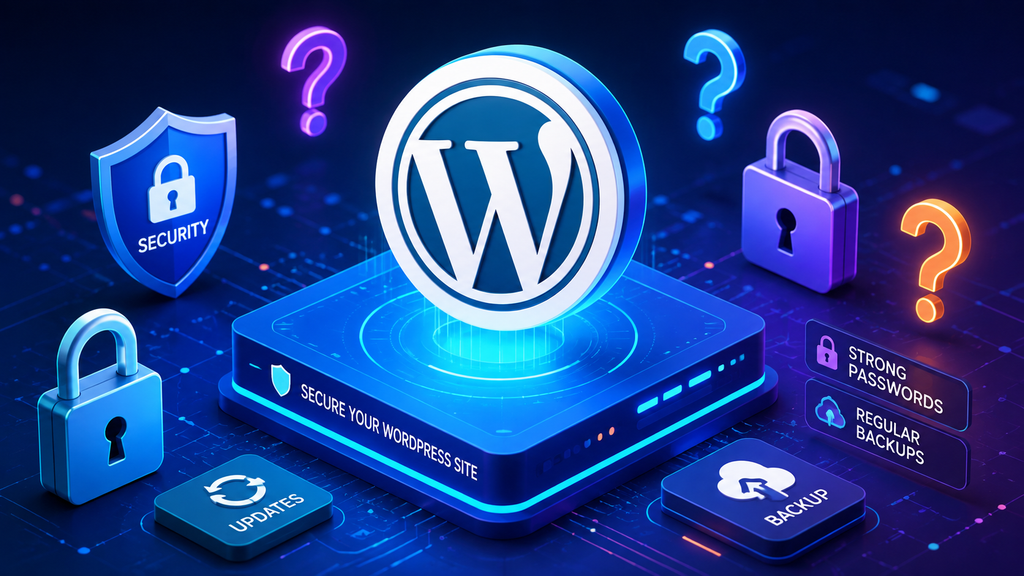
WordPress Security at a Glance: Protect your website by keeping WordPress, plugins, and themes updated, using strong passwords and two-factor authentication, removing unused software, limiting user permissions, performing regular backups, and monitoring for malware. Remember: update → protect → backup → monitor. A few simple security habits can prevent major problems and keep your WordPress website safe, reliable, and trustworthy.
Conclusion
WordPress security is not a one-time task—it is an ongoing process of protecting your website from vulnerabilities, malware, unauthorized access, and data loss. By keeping your WordPress core, plugins, and themes updated, using strong authentication, removing unnecessary software, maintaining regular backups, and monitoring your website, you can significantly reduce security risks. The key is to identify weaknesses before attackers do and make security part of your regular website maintenance.
Call to Action
Don’t wait until your WordPress website gets hacked. Take action today by reviewing your website’s security, fixing potential vulnerabilities, and putting reliable protection in place. Need help securing your WordPress website? Contact us for a professional WordPress security audit and protect your site before it’s too late.